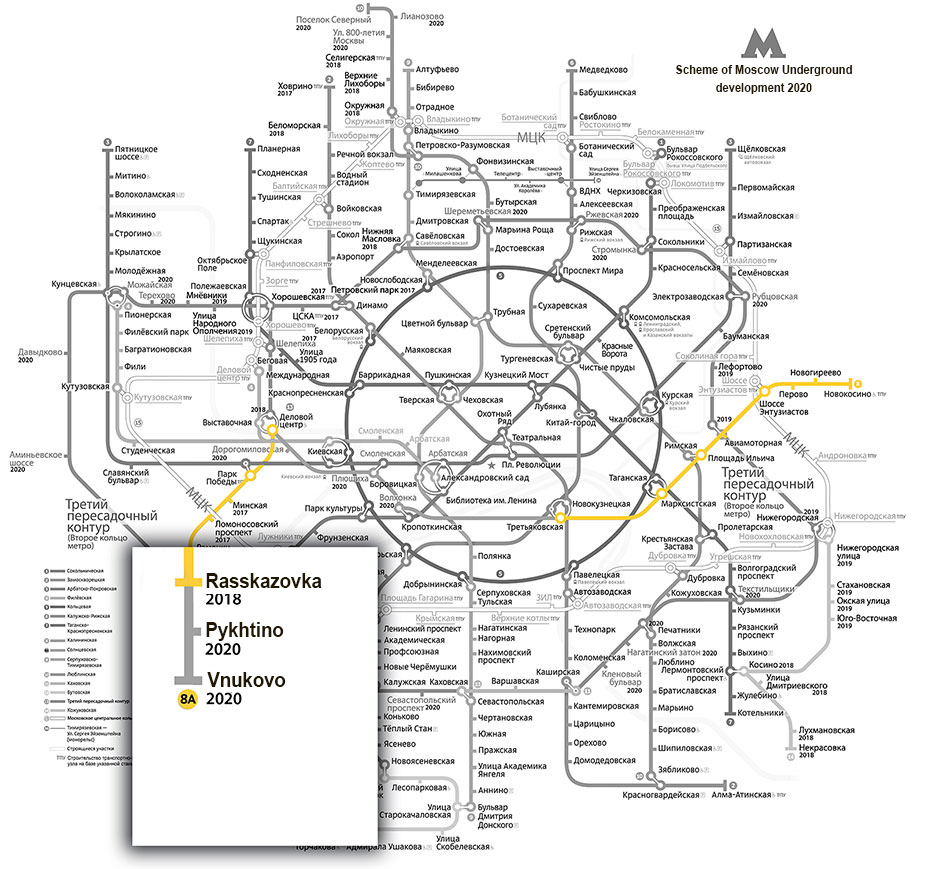
Source: stroi.mos.ru
The Moscow metro system develops rapidly and the decision to connect the center of the city with one of the airports by metro line was only the matter of a time. Many European large cities like Paris, Berlin, Munich, Barcelona and Istanbul have the metro connection with their airports and it is natural for Moscow to follow their example.
In St Petersburg the question of the transportation link to the airport has been discussed for many years. With a large number of tourists visiting the city each year, St Petersburg still welcomes guests to the airport with the only transport link being the road. It may cause some troubles due to the traffic jams sometimes. The City Administration did not keep the promise to take up the challenge by the end of 2018.
— Andrey Nikolaevich, you run one of the largest design establishments in St Petersburg with the number of staff close to 400. What do all these people do? At the first glance, St Petersburg metro system does not have too many stations, but you do many projects across the country and abroad, right?
— The institute is heavily engaged with the projects in Russia, mainly metro stations in Moscow and St Petersburg. Frankly speaking, there are no foreign projects running at the moment, it is more about suggestions. We have some offers – mostly to provide consultations, and we consider them. Right now we are in discussion about some strategic transport links planning in India, in the areas close to China. The construction work will be implemented there by local companies, the Russian company RZD International and the Italian Geodata, the project will be developed by Geodata and our Lenmetrogiprotrans.
— So you do not run at the moment any big foreign project as you did in Syria and Algeria once?
— There is no time, the engagement of the institute is triple, especially now when we have a lot of work with the Moscow metro system. If we add one large project more, we will struggle with the HR issues, and we are not ready to employ many people suddenly as we are highly concerned with the quality of our work. With a background like that, our Syrian and Algerian projects make barely 5% of the total usual engagement of the organisation.
— And what about other 95%?
— Metro, of course. The only time the tunnels took over the majority of the working plan was the period of the preparation work for the Olympic Games in Sochi, the tunnels made 60% of the designed projects.
— Now you have some projects in the Far East, the tunneling of the second Baikal was completed recently according to your design. Could you tell us about the other well-known projects in this area – long time project of the tunnel to Sakhalin island, for example? A couple of years ago the President mentioned it in his annual press conference, how did it change its fate?
— The project is relevant and the meetings with authorities and designers are held. Currently, we are at the stage of the basic design. Those who involved in the bridge construction suggest their projects for 516 million rubles, our cost is about 98. Furthermore, the tunnel has more advantages in this case due to the climate conditions, maintenance cost and the cost of the construction itself. We plan the route to go from the cape Sredny to the cape Pogibi in 100 meters to the South from the route designed in 1951. This solution matches the route of the railroad. And we suggest one-track tunnel.
Both capes have quite difficult geological structure, so we specified the measures against seismic vulnerability 9. If we work from both ends with two EPB TBMs the construction will be finished in 4.5-5 years. The design has not been confirmed yet. There are still some doubts about the final decision. It will be safe to say the transport link will be constructed, whether it will be the bridge or the tunnel stays uncovered.
— When do you expect the final decision to be made?
— It is hard to say, another project mentioned recently by the President won the priority status – the tunnel under the Gulf of Sevastopol.
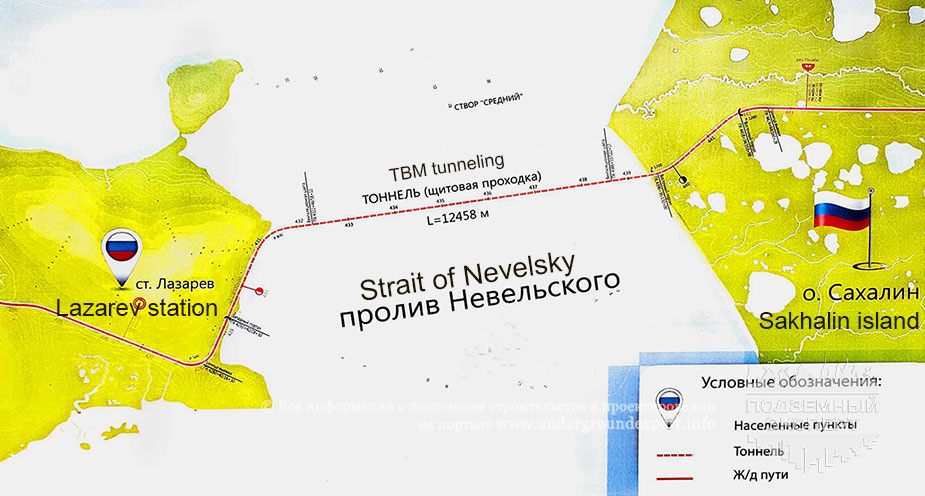
The possible design of the tunnel in the Strait of Nevelsky, ОАО NIPII Lenmetrogiprotrans
— Are you engaged in this project as well?
— Yes, we do the financial calculations, consider the solutions, actually, the situation is similar to the Sakhalin link: bridge or tunnel? This particular project has been suspended for a long time. The southern bank gives us a lot of challenges since there are many buildings along the route of the future road. It is Sakhalin situation with random two bears wandering in the field, here we have a great deal of the expensive real estate and some historical buildings like the old hospital of Sevastopol marines built in 1930–40. We do not know yet the zones. And it is hard to establish if it is harder to make a bridge connection or a tunnel for many reasons influencing the final decision besides the financial.
I used some developments we made for the Orlovsky tunnel which has never been implemented. So the work was not useless. But it is not rare when the work stays uncalled. We did the project of the road tunnel in Primorsky district of St Petersburg and the bridge was chosen later. The Western High-Speed Diameter there could have one tunnel as well, but once again the authorities decided for the bridge.
Andrey Soloview shows numerous folders with the papers and plans staffed inside which cover his two working desks and shelves. The designs of the tunnel in Tuapse, tunnel at the Primorsky prospect, the huge folder with the designs of the Orlovsky tunnel and many others, developed and never implemented.
— Could you estimate the ratio of the projects passing the stages of development and expert estimation and then staying unimplemented?
— It is 50/50. The half of our work stays in our offices.
— What returns such a devastating result, the system of the work management or other reasons?
— More likely the former, many rejections are based on the changes in the in the initial situation or political reasons. For example, we developed the design of the Arkhotsky rail tunnel. This tunnel through the Greater Caucasus Mountain Range, 23 km long. And then what happens? The war in Chechnya started on the one side, and the political situation escalated in Georgia on the other side. Long-term projects may encounter the situations changing their fate and not depending on the designers or construction workers.
Sometimes it is really game of chance. We had been fighting for the tunnel solution for the transport connection in Crimea and instead of Kerchensky bridge, there might be a tunnel. We suggest the same solution that proved itself authoritative under the English Channel. But when we announced the price, the bridge constructors lowered theirs to the same level and got the contract. Also, the advantages of priority influence the decision as well. The tunnels are better from the point of safety and maintenance, the bridge allows more traffic, it has to be four-lined at least due to the technical requirements of lateral rigidity. The tunnel might have 2 lines. Do we need more lines in all the cases? The extra lines make extra expenses.
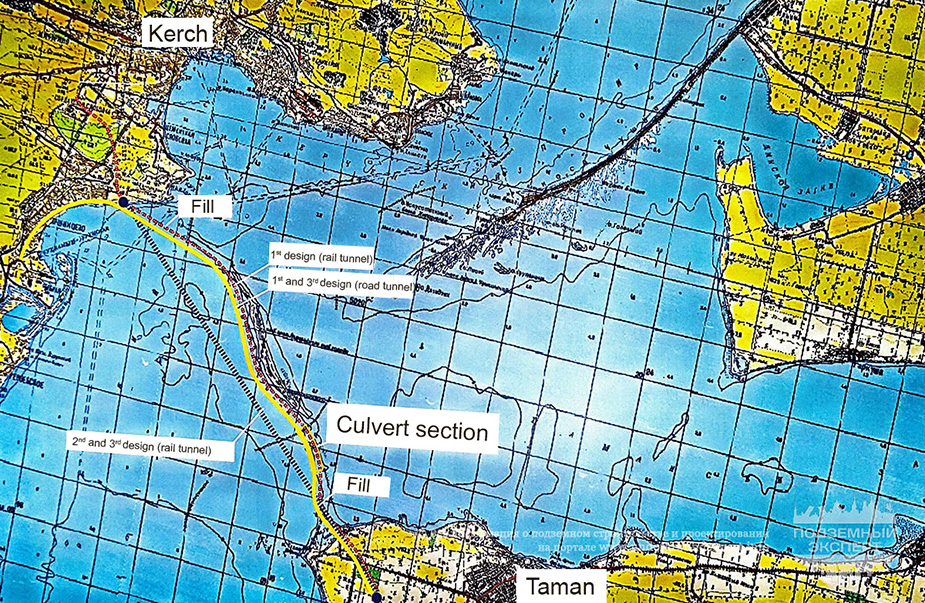
Layout schematic of the tunnel under the Kerch Strait
— May we say the tunnel construction became less expensive in the last decade or two? Can we demolish the myth about its fantastic high prices used many times during the public talks about underground construction?
— In theory, the construction process itself became cheaper even without the fact about less expensive further maintenance in the future. It happened mostly thanks to the advanced technologies. The pace of construction increased the number of required workers lessened. For example, the first Baikal tunnel had 2000 people engaged and only 4000 worked at the construction of the second Baikal tunnel. One kilometer of the tunnel in Novorossiysk several years ago cost about 50 million euro, now our eastern tunnels cost 40 million per kilometer. The cost rises when the construction process is divided between several organizations, which do not very well coordinated.
— The river Amur is not far from these tunnels. And your institute developed recently the design for the tunnel underneath it. The same specialists work at the projects of the underground and submerged tunnels? What can you say about the cost of the underwater tunnels?
— The competent person makes tunnels in all settings. And the tunnel under Amur is not constructed from the start, we talk about redevelopment, so we cannot compare the actual price. The route is not straight, 7 km long, with 10 workings. The unique structure is the second longest tunnel in Russia (The first is the rail tunnel Severomuyskiy as part of the BAM, also designed by Lenmetrogriprotras).
We proceeded with these projects slowly and got the positive answer from the State Expertise. If the funding is found there will be the tunnel. If they had to start a new tunnel, it would cost about 30 billion rubles, reconstruction costs 22. Anyway, it is a serious amount of money, but the design got approval and can be implemented.
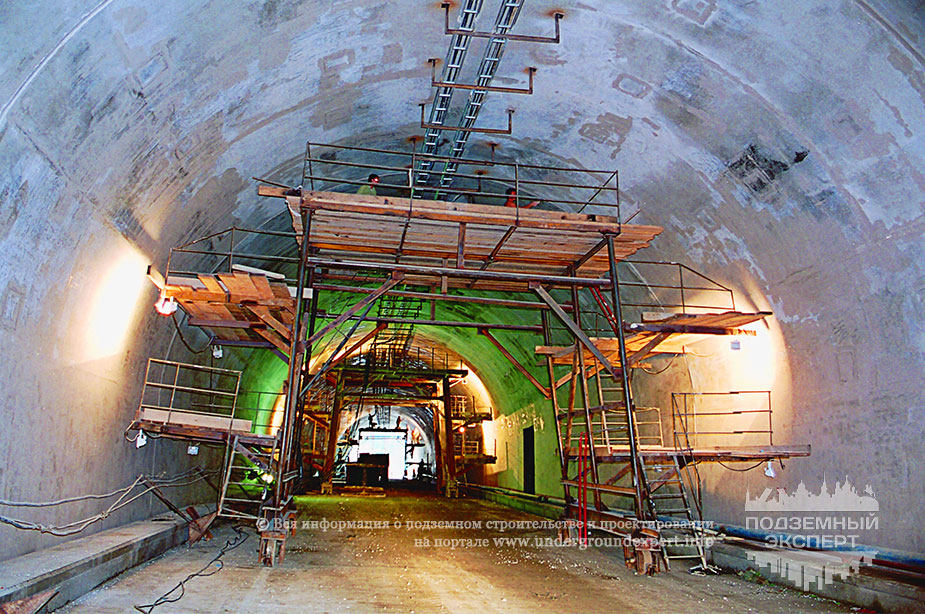
Construction of the tunnel in Sochi, 2002
— May we declare Lenmetrogiprotrans the leader in Russia by the number of the designed projects? Did you surpass Metrogiprotrans, the Moscow-based design institute your institute before was a branch of?
— Absolutely! Since 1984 by the decree of the Ministry of Construction Lenmetrogiprotrans appointed the head design organization for the mountain transport tunnel planning, for example.
— Which universities prepare specialists for your institute? Do you hire in St Petersburg or from all the cities of Russia?
— The Mine Univerisity, St Petersburg State Transport University, St Petersburg State University of architecture and civil engineering. But we have employees from all the country, we do not set any restrictions. If there is competence, we offer a position.
— About competence, what do you think about the latest Elon Musk project The Boring Company? How realistic are these ideas?
— It is the matter of funding. With the suitable amount, the tunnels will be constructed. It is not from the realm of fantasy.
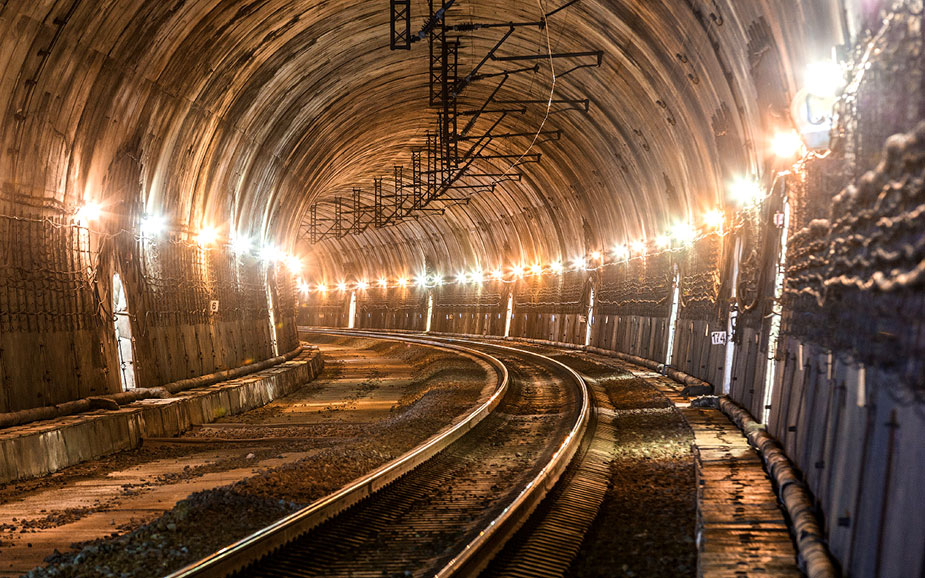
The second Baikal tunnel. Photo: Aleksandr «Russos» Popov.Source: russos.livejournal.com
— Let’s talk about ambitious projects, what can you possibly tell us about the tunnel under the Bering stray? The institute developed the basic design, right?
— In 90es, the preliminary analysis and calculations were made. But it was more about dreaming up than designing. Although we still keep the preliminary schemes somewhere, might be useful for the further experience.
— How differs the difficulty of the tunnel designing in terms of their application? For example, you designed underground neutrino laboratory in the Northen Caucasian mountains, the underground laboratory in Lomonosov and in Gatchina.
— I could tell you something mystifying and vague about details and peculiar specifications, but frankly speaking, with our experience it is all the same. We survey, calculate, design and then go forward and work.

Background information:
Population of the city: 2.87 million
Passenger traffic per day: 675,000
Total Length: 60 km
Number of stations: 74
Number of lines: 3
Start operating: 9 February 1955
The public transport system of the capital of modern Italy is quite extended, allowing the numerous tourists easily to reach the Eternal City from the Leonardo da Vinci International Airport – Rome Fiumicino Airport. The Metropolitana di Rome – the metro system of the city is in the base of it. The Roman metro was accepted into service on 9 February 1955. The construction started before the the World War II. Then, in the 30s of the last century, the work was suspended and the tunnels served as the bomb shelters. The construction resumed in 1948.
The conditions in Rome for the metro construction are difficult, not only due to the geological status, but because of the so-called occupation layer – old structures buried under the new streets of the old city. The treasured archeological finds are often during the construction, the archeologists are happy, while metro construction workers are delayed in their progress.
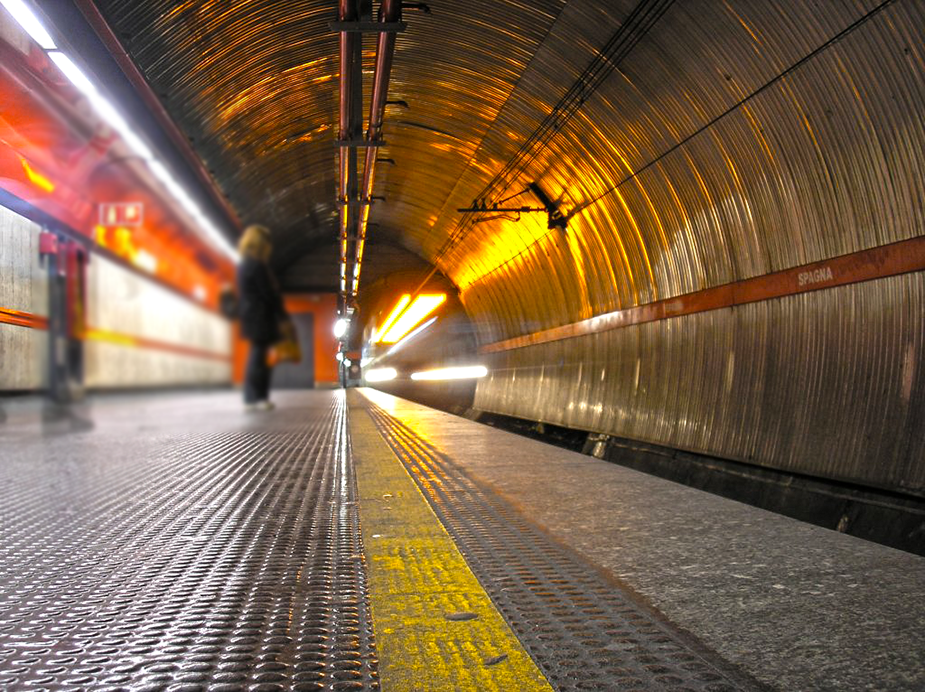
The fare for the trip in the Roma Metro is 1.5 Euro. Also the system of the travel privileges exists, including tourist options. Children under 10 ride free.
The waiting time passengers may see at the special electronic boards. Usually the gap between the trains ranges between 3 and 10 minutes, depending on the time period.
The Rome Metro operates from 5:30 to 23:30, on Friday and Saturday until 1:30.
The entrance to the metro of Rome marked with the letter M in the red square
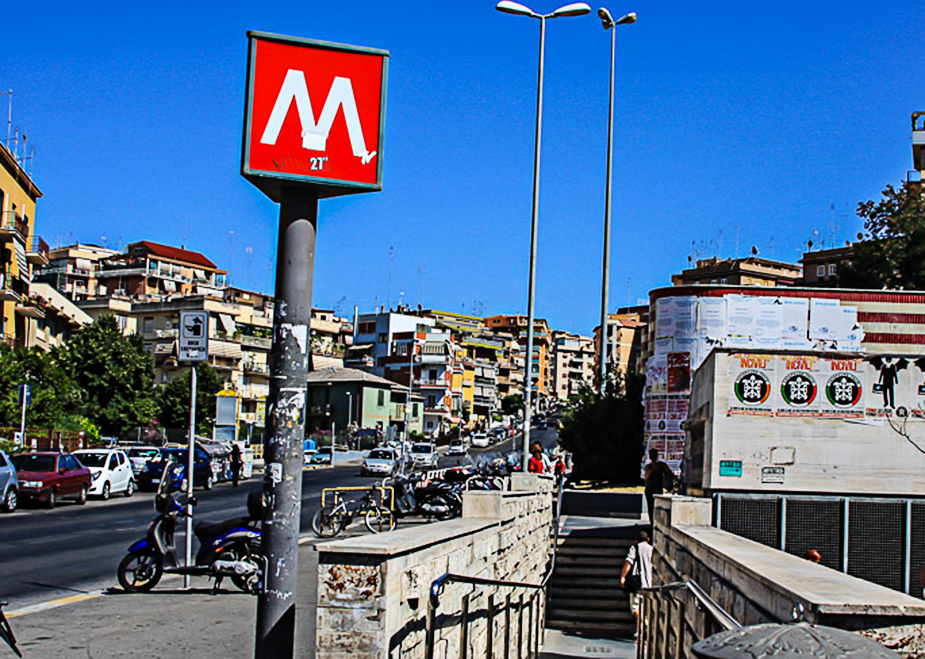
The metro system of Rome includes 74 stations at 3 lines (A, B and C). In the center of the city the stations are placed underground while in suburbs the majority of the stations are on the surface. Also the railroad Rome – Lido is also officially a part of the metro system. It was opened back in 1924 and connects Rome with one of the most picturesque suburbs Ostia Antica. The only interchange station is Piramide at the line B.
The Line B (blue) was the first to be commissioned for operation, in 1955. The Line A (orange), started operating in 1980, and the Line C (green) – the new line, opened only in 2012. The line C rapidly develops and has some particular difficult sections: the interchange station San Giovanni is planned right next to the famous Colosseum in the close vicinity of the preserved archeological treasures of Rome. The other interchange station with the recently planned line D will be the station Piazza Venezia. At present, there are 21 stations at the line. When finished, the line will be 30 km long and will include 30 stations.
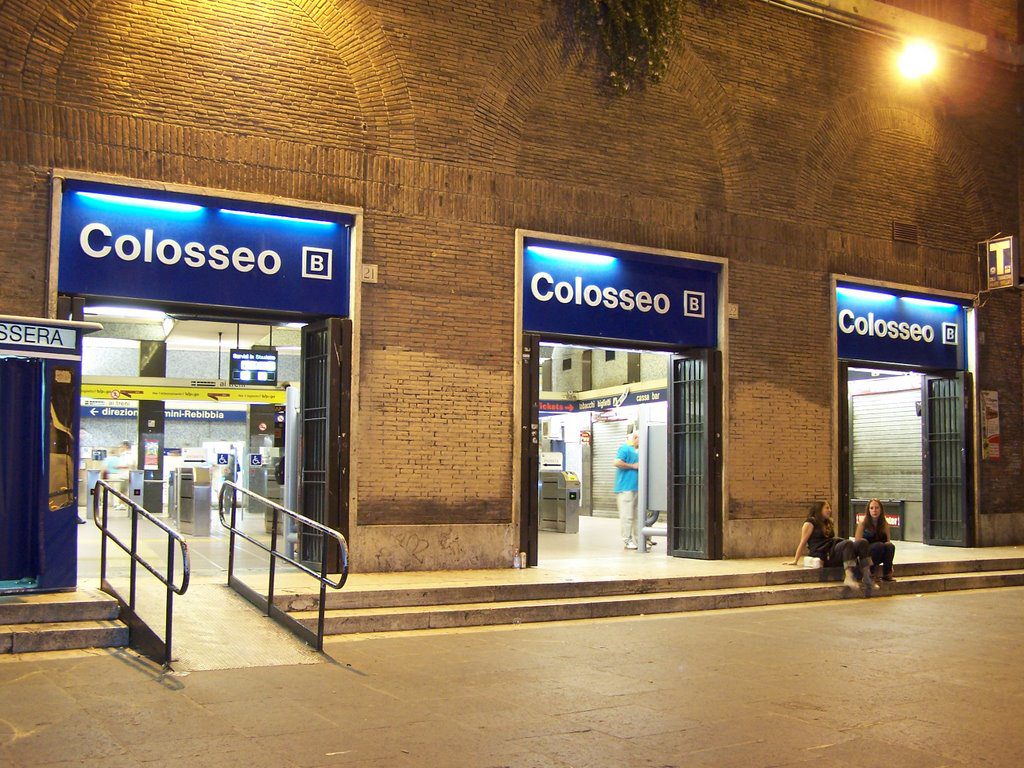
The Colosseo metro station entrance hall. Source: panoramio.it
The new underground stations of the Roman metro have the horizontal lift system, when the platform and the rails are separated by the barrier with the automatic doors. The average distance between stations is 800 m. Each station is equipped with the WC (charged). The interior design is usually quite modest and simple. But hardly the rich decorations underground are needed in the city where the streets themselves are the part of the open-air museum.
The construction of the line C continues, although due to the constant stops for archeological researches, the pace of the construction is slower than originally planned. The most complicated station San Giovanni is opened, with the architectural heritage of the capital of the Roman Empire being still intact.
The Asian Infrastructure Investment Bank (AIIB) granted $335 million of credit for the further development of the metro system of Bangalore.
Yugo-Zapadnaya is a station of the new Krasnosel’sko-Kalininskaya line, which is currently under construction in Saint Petersburg. The project name of the station is Kazakovskaya. It was renamed in 2013 by the City Administration’s decree. Simultaneously, the station Putilovskaya is being constructed at the same line, it will be the interchange station with the existing Kirovsky Zavod station.
NO-DIG Moscow – the first and the only business site of Russia for enterprises that manufacture and operate machinery for trenchless construction, refurbishment and repair of pipelines for various purposes.
The metro system of Moscow rapidly develops and expands, it goes beyond the Moscow Ring Road now. And the new stations are under construction at the territory of the New Moscow. It will take a couple of years for the underground rail road to reach the oldest international airport of the capital of Russia, Vnukovo.
With the another iPhone presentation being held this year in new Apple campus, the fans and experts focused at the new features of the gadget, while there was a lot to notice about the venue itself, namely – the Steve Jobs Theatre. The structure received the name of the Apple creator and ideologist. It is an outstanding object, interesting from the point of its underground part, which reflects global construction tendencies.
Associated research Centers for the Urban Underground Space conference will be held in Hong Kong in November, 2018.
The world conference ACUUS has been held for more than 30 years in different cities around the globe, Hong Kong welcomes it after St Petersburg, where it was held in 2016.
The ITA-AITES World Tunnel Congress is the world’s leading tunnelling event, bringing together tunnel and underground space experts and professionals from all around the world. It is the one tunnelling event you cannot miss!
Join over 2000 engineers and professionals in exchanging the latest trends and innovations, learn from case studies, and discuss how tunnels will support future sustainable cities. Take the opportunity to network at multiple social events and, while you here, experience true Arabian hospitality and enjoy Dubai, the world’s most cosmopolitan city, and all it has to offer.
It is a business complex in Dubai, United Arab Emirates, built by Sheikh Rashid bin Saeed Al Maktoum. It is located along Sheikh Zayed Road at the Trade Centre Roundabout. The complex comprises the original tower (built in 1978), eight exhibition halls, the Dubai International Convention Centre and residential apartments.
Society of Engineers – UAE
Tel: +971 4-2399555
Fax: +971 4-2398887
Email: conferences@soeuae.com
Website: www.soeuae.ae
Secretariat MCI Middle East
United Arab Emirates
Tel: +971 4 311 6300
Fax: +971 4 311 6301
Email: wtc2018@mci-group.com
One more station for Nizhny Novgorod to be opened in 2024. In accordance with the Urban Public Transportation Development project for 2017-2027, the utilities network relocation for the future construction of the section between existing station Gor’kovskaya and designed Sennaya will start in 2019.
Popular articles

October 20, 2017

St Petersburg metro - station Yugo-Zapadnaya
October 20, 2017

The deepest mines in the worlds
October 20, 2017

Sakhalin island tunnel: from the past to the future
October 20, 2017

Modern concepts of architecture for St Petersburg
October 20, 2017
Latest articles

The construction of largest hydraulic tunnel has begun in Qatar
October 20, 2017

Russian city Samara plans to build a metro
October 20, 2017

Moscow Metro expanded by 10 stations
October 20, 2017

Mosinzhproekt can build a metro in Izmir
October 20, 2017
Отправить статью на почту
Статья отправлена на указанный email.
Если вы не видите статью,
проверьте папку spam.
Политика конфиденциальности
1.1. Политика в отношении обработки персональных данных (далее — Политика) направлена на защиту прав и свобод физических лиц, персональные данные которых обрабатывает ООО «Подземный эксперт», далее именуемая в тексте — Оператор.
1.2. Политика разработана в соответствии с п. 2 ч. 1 ст. 18.1 Федерального закона от 27 июля 2006 г. № 152-ФЗ «О персональных данных» (далее — ФЗ «О персональных данных»).
1.3. Политика содержит сведения, подлежащие раскрытию в соответствии с ч. 1 ст. 14 ФЗ «О персональных данных», и является общедоступным документом.
1.4. Политика устанавливает:
1.5. Оператор ведет свою деятельность по адресу: 192102, г. Санкт-Петербург, Фучика улица, д.4, лит. К, помещение 16Н.
1.6. Ответственным за организацию обработки персональных данных назначена Короткова Ольга Евгеньевна (телефон 8(812)3250565, e-mail: korotkova@metrotunnel.ru).
2.1. Персональные данные — любая информация, относящаяся к прямо или косвенно определенному или определяемому физическому лицу (субъекту персональных данных).
2.2. Оператор — государственный орган, муниципальный орган, юридическое или физическое лицо, самостоятельно или совместно с другими лицами организующие и (или) осуществляющие обработку персональных данных, а также определяющие цели обработки персональных данных, состав персональных данных, подлежащих обработке, действия (операции), совершаемые с персональными данными.
2.3. Обработка персональных данных — любое действие (операция) или совокупность действий(операций), совершаемых с использованием средств автоматизации или без использования таких средств с персональными данными, включая сбор, запись, систематизацию, накопление, хранение, уточнение (обновление, изменение), извлечение, использование, передачу (распространение, предоставление, доступ), обезличивание, блокирование, удаление, уничтожение персональных данных.
2.4. Предоставление персональных данных — действия, направленные на раскрытие персональных данных определенному лицу или определенному кругу лиц.
2.5. Уничтожение персональных данных — действия, в результате которых становится невозможным восстановить содержание персональных данных в информационной системе персональных данных и (или) в результате которых уничтожаются материальные носители персональных данных.
2.6. Блокирование персональных данных — временное прекращение обработки персональных данных (за исключением случаев, если обработка необходима для уточнения персональных данных).
3.1. Оператор осуществляет обработку персональных для следующих целей:
3.1.1. для исполнения договора, стороной которого является субъект персональных данных;
3.1.2. установления обратной связи для обработки входящих запросов физических лиц с целью оказания информационных и консультационных услуг, услуг рекламного характера, включая направление уведомлений, запросов;
3.1.3. для продвижения информационных услуг Оператора на рынке путем осуществления прямых контактов с субъектом персональных данных с помощью средств связи;
3.1.4. ведения кадровой работы и организации учета работников Оператора;
3.1.5. привлечения и отбора кандидатов для работы у Оператора;
3.1.6. идентификации посетителя сайта Оператора – https://undergroundexpert.info/;
3.1.7. предоставления посетителю сайта информации о компании и оказываемых услугах;
3.1.8. для достижения целей, предусмотренных международным договором Российской Федерации или законом, для осуществления и выполнения возложенных законодательством Российской Федерации на Оператора функций, полномочий и обязанностей;
4.1. Правовым основанием обработки персональных данных является:
4.1.1. Законодательство Российской Федерации в области персональных данных
основанное на Конституции Российской Федерации и международных договорах Российской Федерации и состоящем из Федерального закона от 27 июля 2006 г. № 152-ФЗ «О персональных данных» и других определяющих случаи и особенности обработки персональных данных федеральных законов;
4.1.2. согласие на обработку персональных данных условия которого подтверждаются
субъектом персональных данных письменно, при работе с формой обратной связи на сайте Оператора, при пользовании сайтом Оператора;
4.1.3. любые договоры, которые заключает Оператор, приложения к данным договорам.
5.1. К категориям субъектов персональных данных, чьи персональные данные обрабатываются Оператором относятся:
5.1.1 физические лица, состоящие в трудовых и гражданско-правовых отношениях с Оператором
5.1.2. физические лица, состоящие в трудовых и гражданско-правовых отношениях с контрагентами Оператора;
5.1.3. субъекты персональных данных, пользующиеся формой обратной связи на интернет сайте Оператора – undergroundexpert.info
5.2. По всем категориям субъектов персональных данных, персональные данные обрабатываются Оператором в рамках правоотношений с Оператором, урегулированных действующим законодательством Российской Федерации.
5.3. По всем категориям субъектов персональных данных, персональные данные обрабатываются Оператором с согласия субъектов персональных данных, предоставляемого в письменной форме, а также без такового, если персональные данные сделаны общедоступными субъектом персональных данных, либо при совершении субъектом конклюдентных действий.
5.4. Оператор обрабатывает следующие персональные данные субъектов персональных данных:
5.4.1. Фамилия, имя, отчество;
5.4.2. Тип, серия и номер документа, удостоверяющего личность;
5.4.3. Дата выдачи документа, удостоверяющего личность, и информация о выдавшем его органе;
5.4.4. Год рождения;
5.4.5. Месяц рождения;
5.4.6. Дата рождения;
5.4.7. Место рождения;
5.4.8. Адрес;
5.4.9. Номер контактного телефона;
5.4.10. Адрес электронной почты;
5.4.11. Идентификационный номер налогоплательщика;
5.4.12. Номер страхового свидетельства государственного пенсионного страхования;
5.4.13. Семейное положение;
5.4.14. Должность.
5.5. Оператором могут обрабатываться иные персональные данные, непосредственно необходимые для выполнения целей обработки персональных данных, в том числе обезличенные статистические данные о посетителях сайта Оператора, содержащиеся в файлах Cookies веб-браузеров посетителей сайта Оператора.
6.1. Обработка персональных данных прекращается Оператором при достижении целей такой обработки, а также по истечении срока, предусмотренного законом, договором, или
согласием субъекта персональных данных на обработку его персональных данных. При отзыве субъектом персональных данных согласия на обработку его персональных данных
обработка осуществляется только в пределах, необходимых для исполнения заключенных с ним договоров и в целях, предусмотренных законодательством Российской Федерации.
7.1. Для достижения целей обработки персональных данных и с согласия субъектов персональных данных Оператор предоставляет персональные данные или поручает их обработку следующим лицам:
7.1.1. государственным органам;
7.1.2. физическим лицам, состоящим в трудовых и гражданско-правовых отношениях с контрагентами Оператора;
7.1.3. физическим лицам, состоящим в трудовых и гражданско-правовых отношениях с Оператором.
7.2. В целях выполнения договорных обязательств или требований федерального законодательства Оператор получает персональные данные от следующих третьих сторон:
7.2.1. Иные лица в соответствии с договором гражданско-правового характера.
7.3. Обработка персональных данных осуществляется с соблюдением конфиденциальности, под которой понимается обязанность не раскрывать третьим лицам и не распространять персональные данные без согласия субъекта персональных данных, если иное не предусмотрено законодательством Российской Федерации.
8.1. Оператор обрабатывает персональные данные на законной и справедливой основе для выполнения возложенных законодательством функций, полномочий и обязанностей, осуществления прав и законных интересов Оператора, работников Оператора и третьих лиц.
8.2. Оператор получает персональные данные непосредственно у субъектов персональных данных.
8.3. Оператор обрабатывает персональные данные автоматизированным и неавтоматизированным способами, с использованием средств вычислительной техники и без использования таких средств.
8.4. Действия по обработке персональных данных включают сбор, запись, систематизацию, накопление, хранение, уточнение (обновление, изменение), извлечение, использование, передачу (распространение, предоставление, доступ), обезличивание, блокирование, удаление и уничтожение.
8.5. Базы данных информации, содержащей персональные данные граждан Российской Федерации, находятся на территории Российской Федерации.
8.6. Оператор вправе поручить обработку персональных данных другому лицу с согласия субъекта персональных данных, если иное не предусмотрено федеральным законом.
Такая обработка персональных данных осуществляется только на основании договора, заключенного между Оператором и третьим лицом, в котором должны быть определены:
9.1. Оператор назначает ответственного за организацию обработки персональных данных для выполнения обязанностей, предусмотренных ФЗ «О персональных данных» и принятыми в соответствии с ним нормативными правовыми актами.
9.2. Оператор применяет комплекс правовых, организационных и технических мер по обеспечению безопасности персональных данных для обеспечения конфиденциальности персональных данных и их защиты от неправомерных действий:
9.2.1 обеспечивает неограниченный доступ к Политике, копия которой размещена на сайте Оператора по адресу https://undergroundexpert.info;
9.2.2 во исполнение Политики утверждает и приводит в действие внутренние локальные акты;
9.2.3 производит ознакомление работников с положениями законодательства о персональных данных, а также с Политикой и внутренними локальными актами;
9.2.4 осуществляет допуск работников к персональным данным, обрабатываемым в информационной системе Оператора, а также к их материальным носителям только для выполнения трудовых обязанностей;
9.2.5 устанавливает правила доступа к персональным данным, обрабатываемым в информационной системе Оператора, а также обеспечивает регистрацию и учёт всех действий с ними;
9.2.6 производит оценку вреда, который может быть причинен субъектам персональных данных в случае нарушения ФЗ «О персональных данных»;
9.2.7 производит определение угроз безопасности персональных данных при их обработке в информационной системе Оператора;
9.2.8 применяет организационные и технические меры и использует средства защиты информации, необходимые для достижения установленного уровня защищенности персональных данных;
9.2.9 осуществляет обнаружение фактов несанкционированного доступа к персональным данным и принимает меры по реагированию, включая восстановление персональных данных, модифицированных или уничтоженных вследствие несанкционированного доступа к ним;
9.2.10 осуществляет внутренний контроль соответствия обработки персональных данных ФЗ «О персональных данных», принятым в соответствии с ним нормативным правовым актам, требованиям к защите персональных данных, Политике, Положению и иным локальным актам, включающий контроль за принимаемыми мерами по обеспечению безопасности персональных данных и их уровня защищенности при обработке в информационной системе Оператора.
10.1.1. на получение персональных данных, относящихся к данному субъекту, и информации, касающейся их обработки;
10.1.2. на уточнение, блокирование или уничтожение его персональных данных в случае, если они являются неполными, устаревшими, неточными, незаконно полученными или не являются необходимыми для заявленной цели обработки;
10.1.3. на отзыв данного им согласия на обработку персональных данных;
10.1.4. на обжалование действий или бездействия Оператора в уполномоченный орган по защите прав субъектов персональных данных или в судебном порядке.
10.1.5. Для реализации своих прав и законных интересов субъекты персональных данных имеют право обратиться к Оператору направив лично или с помощью представителя запрос, содержащий сведения, указанные в ч. 3 ст. 14 ФЗ «О персональных данных по адресу, указанному в пункте 1.5 настоящей Политики.
11.1. Используя сайт Оператора (просмотр, чтение текста, отправка или загрузка информации) и предоставляя свои персональные данные, посетитель сайта дает согласие на обработку персональных данных в соответствии с данной Политикой.
11.2.Настоящая Политика в отношении обработки персональных данных может быть изменена Оператором в одностороннем порядке путем размещения новой редакции в сети Интернет по адресу https://undergroundexpert.info/politika-konfidencialnosti/




Post the comment: